The Lotus Sūtra (Skt. Saddharmapuṇḍarīka) may be the best known Mahāyāna Buddhist scripture; at least in East Asia, from a relatively early period it assumed a position of special, even unique, influence. While its impact in the Indian subcontinent itself appears to have been limited, it was highly honored in Central Asia in its Sanskrit form, to judge from manuscript evidence. Its major historical impact, however, no doubt took place through its Chinese translations, in which the text received nothing short of wholesale veneration. It may be ironic, therefore, given this imbalance in influence, that the modern scholarly appreciation of the Lotus Sūtra, and of Mahāyāna Buddhist scriptures in general, was shaped by the discovery of Sanskrit manuscripts of the sūtra; in Nepal in the first half of the 19th century. The generously annotated translation of the text by the groundbreaking French scholar Eugène Burnouf in 1852, which remains a landmark of scholarship, transformed Western appreciations not only of the sūtra, but of Buddhism tout court. The sūtra was thus not only crucial for the formation of Mahāyāna Buddhism, especially in East Asia, but it stands at the fountainhead of modern studies of Buddhism as well. M. Deeg (2012) offers a survey of the Western translation and reception history of the sūtra.
Although it would be rash to speak of a single main idea of the sūtra, one dominant theme is the primacy of Śākyamuni Buddha. Facing the potential crisis of the spiritual vacuum caused by the absence of the Buddha from the world, the authors of the Lotus Sūtra responded with a radical revaluation of Śākyamuni’s presence. Whereas other plausibly more or less contemporary Mahāyāna scriptures, while certainly not disparaging Śākyamuni, rather promote the sanctity of other buddhas, such as Amitābha/Amitāyus or Akṣobhya, or of the ineffable teaching itself, as one sees in the Prajñāpāramitā (“Perfection of Wisdom”) tradition, the authors of the Lotus Sūtra focus virtually all of their attention on Śākyamuni, and especially on the mystery of his continued presence in the world after his (for them, only apparent) nirvāṇa. The scripture promotes itself and its vision by proclaiming that while the Buddha – as universally accepted and shared Buddhist history maintains – taught several paths to spiritual advancement, it is in actual fact only the teaching of the Lotus Sūtra itself which is Śākyamuni’s perfect teaching, his ultimate message of salvation and liberation. Thus the eternal buddha Śākyamuni is portrayed as employing skillful means (upāya) to cultivate all beings, according to their various capacities, one such means being the manifestation of a death in nirvāṇa, though in reality there is only a single approach (ekayāna, “unique vehicle”), and through that single approach all beings will attain buddhahood. While Śākyamuni is eternal, phenomenally his life came to an end in this world, and his successors, bodhisattvas, emerging from out of the earth itself, should preach this truth to others and energetically promote its salvific message. This message that all beings can attain buddhahood because they are bodhisattvas, future buddhas, is a groundbreaking revolution in Buddhist history, and among other things leads to a reorientation which values life and practice in this world, in contrast to the dichotomous saṃsāra-this world/nirvāṇa-other world distinction of the earlier tradition. The Lotus Sūtra is also especially important for its portrayal of the savior figure of the bodhisattva Avalokiteśvara (Chn. Guanyin [觀音]), doubtless the most prominent and influential bodhisattva in all Mahāyāna Buddhist lands, a prominence this figure attained in no small part precisely thanks to his portrayal in the Lotus Sūtra itself.
Sources
The Lotus Sūtra may originally have been composed in a form of Middle Indic (see below), at an unknown date but perhaps sometime just before or after the beginning of the 1st millennium ce. It is not possible to know where this may have taken place. While no direct traces of this stage of textual development are known to exist, we do have a large number of Sanskrit manuscripts of the sūtra, preserved in several regions of Asia (an outdated but still useful survey of sources is Yuyama, 1970. For more recent information see Yuyama, 1987, Tsukamoto, 1986, and Toda, 1997. Mochizuki, 1998, provides a catalogue of articles. Regarding research on Central Asian manuscripts see Nakamura, 1980, 184–185n7, and, for more recent work, the material listed in Wille, 1998, 241n2). The manuscripts have been divided by scholars according to their textual filiations: (1) Nepalese manuscripts; (2) Gilgit manuscripts; (3) Central Asia manuscripts; and (4), Afghani manuscripts. (1) & (2) are relatively similar and together compose one group. The most numerous manuscripts are those preserved in Nepal. A number of these have been published in transcription (especially by Toda Hirofumi [戸田宏文] and through the Institute of Oriental Philosophy of the Sōka Gakkai), and in facsimile, for example by Tsukamoto et al., 1977–1982, and also more recently in beautiful color reproductions, again by the Institute of Oriental Philosophy. We owe the existence of the manuscripts from Nepal primarily to the fact that as one of the “nine dharmas,” the text had (as it continues to have) a ritual importance in Nepal, and was thus frequently copied in this context. These manuscripts, or modern copies thereof, are found in collections around the world. Older manuscripts, or fragments thereof, some dating back to the 5th century ce, have been preserved in the extreme Northwest of the South-Asian subcontinent, in Gilgit (Group [2] in the above classification, Watanabe, 1972–1975, von Hinüber, 1982; von Hinüber, 2012), and in several spots in Central Asia (Group [3], Kashgar: Baruch, 1938; Bechert, 1972; Lokesh Chandra, 1976; Khadalik: Wille, 2000; Turfan and other sites: Jiang, 1997). Research on the Kashgar versions (more precisely the Marburger fragments; Bechert, 1972) and especially on the oldest Chinese translation by Dharmarakṣa (see below and Karashima, 1992; 1998) suggest that there once existed a version of the sūtra; in a northwestern Middle-Indic dialect, but no direct evidence for such a version has yet been found. Later manuscripts are either in Sanskrit or, like the Nepalese manuscripts on which the editio princeps of H. Kern and B. Nanjio (1908–1912; see below) is primarily based, are largely written in so-called Buddhist Hybrid Sanskrit. While most manuscripts were probably meant either for recitation or ritual use, some were clearly intended primarily as objects as such, that is, for devotional purposes. In East Asia a great number of Chinese manuscripts were produced with tremendous attention given to their visual appearance (see below).
The pioneering edition of the Sanskrit text was published in 1908–1912 by Hendrik Kern (1833–1917) and Bunyu Nanjio (Nanjō Bun’yū [南条文雄], 1849–1927). Being based on a collation of Nepalese manuscripts made by B. Nanjio, contrasted by H. Kern with a then newly-available Central Asian manuscript, the result has been criticized as a conflation of distinct recensions. However, this is probably too harsh a judgment, since H. Kern’s aim was to seek the underlying unity and correct the Nepalese text in light of what he saw as the original shape of the text (for a reappraisal see Vetter, 1999; Silk, 2012). This edition continues to be the most widely used; although a great deal of research has now been published on the Sanskrit sources, no up-to-date critical edition of the text as a whole has yet appeared. A start on some portions has been made by Seishi Karashima (2003; 2004; 2005a; 2006a), taking into account all available evidence. The publications of Wogihara and Tsuchida (1934–1935; an index is Itō, 1993) and P. L. Vaidya (1960) have little to no independent value.
The text was translated into English from Sanskrit by H. Kern (1884), even before the publication of the first Sanskrit edition. This remains the only published English rendition of the Sanskrit. Along with the above-mentioned translation by E. Burnouf, the sūtra has been translated into Western languages repeatedly, virtually always based, however, not on Sanskrit sources but rather on the Chinese translation of Kumārajīva (representative examples are Hurvitz, 1976; Watson, 1993; Robert, 1997; Deeg, 2009; for a briefly annotated list of translations see Teiser and Stone, 2009a, 237–240, who list 15 separate items, though this is clearly incomplete; for instance Meazza, 2001, translates from Sanskrit into Italian). The sūtra has been repeatedly translated into modern Japanese (including a number from Sanskrit, and at least one from Tibetan), and into other Asian languages. While few of these are of scientific utility, they more importantly well illustrate the degree of continuing, and growing, popular interest in the sūtra.
Like most such scriptures, the Lotus Sūtra is known not only in its Indic language form but also in translations. A Tibetan rendering is preserved in the Kanjur, Dam pa’i chos padma dkar po (D 113/ P 781), made in the 9th century ce by Surendrabodhi and Sna nam Ye shes sde (a rudimentary edition is Nakamura 1976–1997; the pagination is conveniently made to match the Sanskrit edition of Kern and Nanjio). However, an older or unrevised translation also exists, and is of great philological significance. The text, however, like most sūtras, does not appear to have played any significant role in Tibetan Buddhist thought or practice.
The historically most influential versions are, without doubt, those in Chinese. Four are preserved, another three are recorded as having been completed, but were lost. The available versions are the following:
- Zhengfahua jing (正法華經; T. 263) by Dharmarakṣa (fl. 265–313 ce), dated to 286 ce
- Miaofa lianhua jing (妙法蓮華經; Jpn. Myōhō renge kyō; T. 262) translated in 406 ce by Kumārajīva (350–409 ce)
- Tanpin miaofa lianhua jing (添品妙法蓮華經; T. 264) by Jñānagupta and Dharmagupta, produced in 601 ce; and
- Satanfentuoli jing (薩曇分陀利經; T. 265), may belong to the Western Jin (西晋; 265–316 ce; corresponding to ch. 11 only, see below).
Although the Zhengfahua jing, the oldest translation, had an impact on developing Chinese Buddhist traditions, it is rather the Miaofa lianhua jing that was to have the most lasting importance for all of East Asian Buddhism, down to the present day. The Tanpin miaofa lianhua jing is a sort of revision of the translation of Kumārajīva, with commentarial notes. Finally, the Satanfentuoli jing (the title is a phonetic transcription of Saddharmapuṇḍarīka) is a rendering of a single chapter, corresponding to chapter 11 (see below).
Karashima (1992, 253–260) argued that the Zhengfahua jing and Miaofa lianhua jing are more closely related to the Sanskrit recension found in the Central Asian manuscripts than to that represented by the Gilgit-Nepalese manuscripts, while in contrast the Tianpin miao falianhua jing corresponds more closely to the Gilgit-Nepalese recension. The Zhengfahua jing is particularly important for the light it sheds on stages of development of the sūtra even older than the oldest evidence provided by Sanskrit manuscripts.
Although the text circulated widely in China in manuscripts and later xylograph form, we can get some notion of its earlier popularity from the Dunhuang collections. S.F. Teiser calculates that there are something like 4,500 separate manuscript copies (complete or partial) of the Chinese Lotus Sūtra – mostly the Miaofa lianhua jing – in the main Dunhuang collections, but surely many more once existed. One manuscript (Pelliot chinois 3788) is a single surviving example of 3000 that were copied in the 680s ce “on behalf of the posthumous fate of the parents of Empress Wu” (Teiser, 2014, 67, 67n131). The text was, moreover, frequently engraved on stone at a number of sites in various areas of China between 600 and 840 ce.
Three additional Chinese translations are recorded in catalogues as having been produced, but they are not known to exist:
- (Zheng) Fahua sanmei jing ([正]法華三昧經) translated by Zhi Jianglangsha (支彊良接) in 255 ce (T. 2154 [LV] 628c21–22)
- Sayunfentuoli jing (薩芸芬陀利經), translated by Dharmarakṣa in 265 ce (T. 2154 [LV] 628c23–26). (Although this is the cited title, it is certainly an old error of 芸 [yun] for 曇 [tan], matching the title of the Satanfentuoli, above.); and
- Fangdeng fahua jing (方等法華經) by Zhi Daogen (支道根) in 335 ce (T. 2034 [XLIX] 69a26–b2; T. 2154 [LV] 628c27–629a2).
The sūtra was also translated into Central Asian languages, including fragments in Uigur (a translation of a Chinese commentary is also known, Kudara, 1988), and the complete text in Tangut (from Kumārajīva’s Chinese translation; Nishida, 2005). Although the text as such was apparently never translated into Khotanese, one quoted verse and a metrical summary are known. As for East Asian vernaculars, although it is perhaps not correct to speak of a “translation” as such, there are records of Kumārajīva’s translation of the Lotus Sūtra being read out in Japanese in a way that was apparently understandable as early as the 11th or 12th century. The date of the first translation of the Chinese into Japanese is unknown, but the oldest complete manuscript of the text in which the Chinese is presented in Japanese reading order – again, not a translation – appears to be that dated to 1330, the Bannaji-bon Kana Hokekyō (鑁阿寺本假名法華經; Kabutogi, 1955; Kawamura, 1979). The first Korean version dates to 1463, a work which combines a Korean rendering of Kumārajīva’s Chinese text, Myobŏb ryŏnhhwa’gyŏng (conventionally Bŏphwa’gyŏng ŏnhae) with a commentary, the Miaofalianhuajing yaojie (妙法華經要解; ZZ 602), by the Chan monk Jiehuan (戒環; ?–1129?). However, the text was apparently never of great importance in Korea.
In some East Asian traditions, Kumārajīva’s text is joined together with the Wuliangyi jing (無量義經; Innumerable Meanings Sūtra; T. 276) and the Puxian jing (普賢經; Sūtra of [Meditation on] Samantabhadra; T. 277) to form the “Threefold Lotus Sūtra” (Fahua sanbu jing [法華三部経]; Jpn. Hokke sambukyō); the latter of the two additional texts, the Puxian jing, is important in Tiantai (天台) repentance rituals.
The text is quoted, though infrequently, by Indian authors. However, a commentary of probable Indian provenance, attributed to Vasubandhu, is preserved only in Chinese translation, the Miaofa lianhuajing youbotishe (妙法蓮華經憂波提舍; *Saddharmapuṇḍarīkopadeśa; T. 1519; study and trans. in Abbott, 1985; T. 1520 may be closer to the original than T. 1519). Although not known in Tibet as such, there is an apparent reference to this commentary in Bu ston’s 14th-century catalogue in his Chos ’byung (History of Buddhism), but nothing else is known of this translation (Nishioka, 1981, #667, pad ma dkar po’i ’grel pa dbying gnyen gyis mdzad pa; see also #664, pad ma dkar po’i don bsdus pa 100 śloka). These may, however, represent translations from Chinese, in which there are a large number of Lotus commentaries. One such commentary, the Miaofa lianhuajing xuanzan (妙法蓮華經玄賛; T. 1723) by [Kui]ji ([窺]基), was indeed known in Tibet, and partially translated as the Dam pa’i chos puṇḍarīka’i ’grel pa (D 4017/P 5518).
A series of indices (Sanskrit–Tibetan–Chinese; Chinese–Sanskrit; Tibetan–Sanskrit) was prepared based on the Kern-Nanjio edition. Very valuable glossaries of the two Chinese translations of Dharmarakṣa and Kumārajīva have also appeared.
Doctrines
The Lotus Sūtra is renowned not only for its doctrinal contents, which put forth a striking vision of a timeless Buddha and his salvific intent, but for its style. Some of this reputation is based on an appreciation of the beauty of the language of Kumārajīva’s translation, but the structure of the sūtra is also esteemed. The presentation of Śākyamuni as transcending the bounds of time is central to the Lotus’s vision. The Buddhist communities which followed the generations after the death of the Buddha obviously faced a problem: how to maintain the charisma and power of the Buddha in a world from which he was now absent. One solution is that promoted by the Lotus Sūtra: drawing on ideas found elsewhere, such as the contingency of our ordinary ideas, the empty reality of selflessness and so on, the authors of the Lotus offer a Buddha who is now every bit as present in the world as he ever was. One way of understanding this solution is the via negativa, as in the Prajñāpāramitā tradition, but for the authors of the Lotus, and for its followers, the result is instead a world in which not just buddhahood as a potential but the Buddha himself is eternally present and accessible. This powerful vision has permeated the reception of the Lotus Sūtra down to today, and its theology has had a profound impact on virtually all of Mahāyāna Buddhism, directly or indirectly.
The text presents itself in a form rather more narrative and poetical than is common in Mahāyāna scriptures. The narratives, and especially parables, which populate the text convey the diverse themes and messages of the sūtra; in a sometimes quite dramatic fashion, which is underscored by the huge audience of human and celestial beings, the frequent display of cosmic miracles of illumination, and the apparition of myriads of buddhas and bodhisattvas. These doctrinal and thematic emphases of the different parts of the sūtra – possibly related to its historical phases of composition – are reflected in certain key terms. One of the most important is upāyakauśalya (Chn. fangbian, Jpn. hōben [方便]), the “skillful means” used by the Buddha to explain the dharma in ways appropriate to his audience. Also central is the notion of the ekayāna (Chn. yisheng [一乘]), “one/single/unique vehicle.” The authors of the text faced the challenge of explaining why, if the Buddha is omniscient, and moreover infinitely compassionate, he should nevertheless teach paths which are anything less than perfect. In other words, why, alongside the buddhayāna, or as it is sometimes called the mahāyāna or bodhisattvayāna, did he deign to teach the path of the auditors (śrāvakayāna) and of the lone buddhas (pratyekabuddhayāna), in all the triyāna, the “three vehicles”? The sūtra answers that the path of the auditor and of the lone buddha are none other than skillful means propounded in order to save beings in a fashion appropriate to their individual (limited) levels of spiritual maturity: the ultimate teaching is indeed nothing other than that of the Lotus itself. The sūtra, moreover, emphatically promotes itself as a Vaipulyasūtra, a term which may be synonymous with Mahāyāna, but which the text contrasts with other varieties of teaching (such as [mere] sūtras, gāthā, etc.). All of these examples illustrate the intention of its authors to raise the Lotus above all other expressions of Buddhist scripture, placing it into a category beyond, an attempt which the history of the text demonstrates to have succeeded admirably.
The notion of the ekayāna and the existence of the eternal Buddha were reinforced by the vision of bodhisattvas emerging from the earth to keep, recite and copy the sūtra, and propagate its teaching in the future (ch. 14; Kumārajīva 15). These bodhisattvas hand down one and the same ekayāna teaching for the eternal Buddha generation after generation, and are portrayed as preachers of the teaching (dharmabhāṇaka). The most important example of such a figure is chapter 19’s bodhisattva Sadāparibhūta, the Buddha in a previous life, who proclaims to everyone he meets: “I do not insult you worthy persons! I do not despise you. Why? You all follow the bodhisattva-path, and will become Tathāgatas, Arhats, Perfect Buddhas!”.
While resting entirely within the Mahāyāna project, the Lotus Sūtra sees itself, however, in line with this theme of self-promotion, as transcending a number of traditional modes of Mahāyāna bodhisattva practice, such as the gradual cultivation of virtues enumerated in the six perfections (pāramitā). Instead, it offers as a recurring theme a reflexive focus on the sūtra itself, and a central role for the preacher. The text repeatedly asks its audience to preserve, recite and copy or transcribe it, even if they may be slandered and persecuted (a feature some modern scholars have interpreted as indicating that the sūtra’s authors operated in an environment hostile to their innovative ideas). This is meant to underscore the text’s universal salvific power. Just as in other Mahāyāna sūtras, the ultimate soteriological goal for an individual who has set out on the bodhisattva path is to achieve the “unsurpassable perfect awakening” (Skt. anuttarasamyaksaṃbodhi). However, here this awakening is universal in the sense that every living being striving on the path of bodhisattvahood can achieve it. The presentation of this idea is underlined by the cosmological range of the sūtra, which spans myriads of Buddha worlds and countless eons of time. Since it is difficult to reach the unsurpassable perfect awakening, the text seeks to assure its audience that the goal can indeed be accomplished by having the Buddha offer a prediction (Skt. vyākaraṇa) of the realization of this awakening to a huge number of bodhisattvas, who are present mostly in the latter half of the text. The Lotus itself promises awakening to each and every being. The preacher of the sūtra is to be esteemed just as the sūtra itself is esteemed; he is the living representative in every generation of the expounders of the text, that is, the living representative of the Buddha himself in the world. It additionally should be noted that, with the influential story of the nāga (dragon) girl who attains buddhahood, the sūtra seems to advocate a revolutionary idea that women may attain buddhahood directly (see below; this story is not found in all versions of the text).
In all, it may be that taken individually elements of the rhetoric and doctrine of the Lotus are indeed found elsewhere as well. However, the way these elements are innovatively woven together in the Lotus Sūtra proved to be the key to its success.
Chapter Outline
Although it cannot begin to capture the richness of the text overall, the following overview of the content of the sūtra is based on the Sanskrit version and Kumārajīva’s (K) translation, with the basic differences between them noted. Note, however, that the Central Asian Kashgar manuscripts agree in some key respects with K, against the other Sanskrit lineages. (For a simple table comparing the chapter divisions in the Nepalese Sanskrit and three Chinese translations, see Tsukamoto, 2007, 430–431.)
The sūtra opens with a grandiose display of the Buddha in deep contemplation (samādhi), emitting light from the tuft of hair between his eyebrows (ūrṇā) and illuminating the whole universe in the midst of a huge audience (ch. 1: Nidāna; Introduction; Xu pin [序品]). In chapter two, Upāyakauśalya (Skillful Means; Fangbian pin [方便品]), the Buddha explains that through skillful means he teaches the three vehicles as actually one, a key idea developed throughout the text.
In chapter three, Aupamya (Parable; Piyu pin [譬喻品]), the theme of skillful means is further developed when the Buddha makes a prophecy of future buddhahood to his disciple Śāriputra, and recounts the parable (upamā) of the burning house. Often depicted visually in very dramatic fashion, this illustrates how and why he preaches the dharma differently. The image is presented of the children of a merchant trapped in a burning house; their father knows that the children, intent on their play, will not hear his pleas that they flee the danger they face, but he accomplishes his aim of saving them by luring the children out of the house through the promise to give each of them the toy cart he particularly desires. However, when the children are free of the conflagration, each is rewarded not differentially but with the very best of carts. The message is that while there may appear to be distinct vehicles, in the end the father (Buddha) presents his beloved children only the very best one. In making explicit the metaphor, the sūtra itself has the Buddha reflect that all beings are his children, and the best of carts is explicitly homologized to nothing other than the buddha vehicle (buddhayāna), through which those beings are brought to nirvāṇa. In the chosen imagery there is an obvious link with the early Buddhist “Fire Sermon,” (SN 35.28), in which the Buddha proclaims that the entire world is ablaze with desire, and so on. Here the Lotus Sūtra transforms this earlier Buddhist ascetic vision into one of universal salvation. It is notable that the Buddha is here clearly homologized to the father; the implications of this are profound for developing “theistic” elements in Mahāyāna Buddhism. Regarding the father’s actions and the application of skillful means, the sūtra itself asks whether he lied to his children, to which it replies emphatically that he did not: skillful means appear dishonest only to those who do not understand the intention behind the salvific tactic.
In chapter four, Adhimukti (Conviction; Xinjie pin [信解品]), another of the Buddha’s great disciples, Mahākāśyapa, presents the parable of the prodigal son in order to stress that the Buddha’s message has been presented to all his disciples, but they were not able to realize its true intent. A run-away son, in search of employment, stumbles into his rich father’s estate without realizing who the owner is, or their relationship. The father recognizes his son, but fails to convince him of his true identity. He then knows that revealing to the son his patrimony will be fruitless. Instead, he has his son work on the estate as a common laborer. Only years later, after the son has become a diligent and responsible man, does the father again reveal to him that he is heir to all his father’s wealth. In the same way, the Buddha only seems to have disciples who did not inherit the true riches of his ultimate teaching. In the end, however, these disciples too will share in the Mahāyāna treasures, even though they may seem to be stuck in the poverty of the Hīnayāna, the “inferior vehicle.” This term is of some importance for this sūtra, and plays a role in many later Mahāyāna Buddhist doctrinal developments, but neither in this sūtra nor elsewhere does it ever have any sociologically real referent; it points, instead in a generic way to those who might hold views considered wrong by Mahāyāna authors. The Lotus Sūtra, that is, disparages ideas it finds objectionable, not communities. On the contrary, the sūtra’s message is universalistic: even those on the wrong, limited path are, and have been all along, embraced by the Buddha’s true teaching.
Chapter five, Auṣadhi (Herbs; Yaocao yu pin [藥草喻品]), presents another parable, in which a cloud rains on different plants, including medical herbs, without distinction between their different functions and qualities, and each herb is nourished according to its needs. This demonstrates that the Buddha offers only one vehicle to the different kinds of living beings without distinction, and his teachings are received in individually appropriate ways. In chapter six, Vyākaraṇa (Prediction; Shouji pin [授記品]), the Buddha predicts buddhahood for four of his followers.
Chapter seven, Pūrvayoga, (Former Striving; Huacheng yu pin [化城喻品]; Parable of the Magically Created Citadel), describes at length the career of a buddha of the past (as suggested by the Sanskrit title), Mahābhijñājñānābhibhū. Here the Buddha recounts the story of the past buddha who preaches to the 16 sons of a king. After the passage of huge periods of cosmic time, this buddha again preaches to these young men, this time the Lotus Sūtra itself, which they memorize. Practicing again for very long ages, the 16th of these princes, like his brothers, becomes a buddha himself, none other than Śākyamuni, who in this self-same Lotus Sūtra recounts this very story. In this fashion the sūtra effectively lifts its own revelation out of the limits of time, rendering it both timeless/eternal and authorless. All Buddhist truth is true without the contingencies of time; that is, buddhas realize the truth, they do not create it. But the Lotus differs here in explicitly declaring itself, as a specific articulation of that truth, to also transcend temporality. The chapter ends with the parable of the magic city (as suggested by the Chinese title), which describes the Buddha’s skillful means in leading living beings to salvation: a caravan guide leads a party of men who are expecting to find a treasure at the other side of a desert. (Metaphors of trade are very common in much Indian Buddhist literature.) In order to inspire them, he conjures a city in which they can rest until they are able to resume their journey. Thus, nirvāṇa, as imagined by the earlier dispensation which the Lotus seeks to supersede, is presented as of only provisional meaning. The goal of the earlier teaching is thus reinterpreted as only a skillful means to encourage beings onward to the true goal of perfect awakening, buddhahood.
In chapters eight, Pañcabhikṣuśatavyākaraṇa (Prediction to Five Hundred Monks; Wubai dizi shouji pin [五百弟子授記品]), and nine, Ānandādivyākaraṇa (Prediction to Ānanda and Others; Shouxue wuxueren ji pin [受學無學人記品]; Prediction to Those Who Have Completed and Those Still on the Path), the Buddha again predicts buddhahood for others of his disciples. In the former, the Buddha teaches the parable of a drunken man whose friend secretly sews into his garment a jewel of great price. The man proceeds to live in poverty for years, unaware that he is actually all along fantastically wealthy. After some time his friend meets him again, and is astonished that the man has continued to live in penury, unaware of what had been bestowed upon him – just as the disciples of the Buddha are unaware, in their doctrinal poverty, that the Buddha had actually given them the priceless gift of his Mahāyāna teaching all along.
Chapter ten, Dharmabhāṇaka (Preachers of the Dharma; Fashi pin [法師品]), praises the merits of those who preach and uphold the sūtra (dharmabhāṇaka). Chapter eleven, Stūpasaṃdarśana (Apparition of the Stūpa; Jian baota pin [見寶塔品]), presents the appearance from beneath the ground of the huge stūpa of the buddha Prabhūtaratna, who invites the Buddha Śākyamuni to share his seat within the stūpa. Long ago Prabhūtaratna had himself preached the Lotus Sūtra, and vowed to appear again whenever it was taught. Along with the story of Mahābhijñājñānābhibhū, this argues for the eternality and omnipresence of the Lotus Sūtra on a truly cosmic scale. Most Sanskrit versions continue with the prophecy of buddhahood to Śākyamuni’s archenemy and cousin, Devadatta, which forms a separate 12th chapter in Kumārajīva’s translation, Tipodatuo pin (提婆達多品; Devadatta), and in the Kashgar recension of the Sanskrit. This chapter was evidently not present in the original version translated by Kumārajīva, but was supplemented in the text, in Chinese, when it was revised by Faxian (法献) and Fayi (法意) less than a century after its translation. The sūtra performs a rhetorically powerful move in casting Devadatta, the archetypical foe of the Buddha in earlier normative tradition, as a preacher of the Lotus Sūtra; in a previous age. It was none other than Devadatta, in fact, who preached the Lotus Sūtra to the Buddha himself in one of his past lives. After recounting this tale, the Buddha predicts Devadatta to future buddhahood. This chapter also contains, in some versions (see above), the oft-quoted episode of the transformation of a young nāga girl into a male, who then immediately achieves buddhahood. The text here responds to orthodox Buddhist cosmology, which sees female rebirth as inferior to male status, and to the otherwise virtually unanimously tradition that holds that in order to achieve buddhahood, a woman must be reborn as a male. While the nāga girl does, albeit instantly, become a male, and only thereafter become a buddha, the East Asian exegetical tradition, in particular in Japan, used this episode as textual evidence to promote the possibility for women to attain buddhahood. In the Tendai interpretation, it also became the scriptural source for the notion that enlightenment can be attained instantly in one’s own body (sokushin jōbutsu [即身成佛]), without undergoing multiple rebirths, and this by all sentient beings, since the nāga girl is also considered to belong to the realm of animals, rather than humans.
More prophecies are given in chapter twelve, Utsāha (Encouragment; K: 13, Quanchi pin [勸持品]). Chapter thirteen, Sukhavihāra (Blissful Condition; K: 14, Anle xing pin [安樂行品]), explains the proper conduct, the proper sphere of relationships and blissful ways (sukhavihāra) of a bodhisattva in order to preach the sūtra; in the age of decay of the dharma. This chapter would acquire liturgical importance in East Asia as the textual basis for the repentance rituals known as fahua chanfa (Jpn. hokke senbō [法華懺法]), drawing on the Fahua jing anle xing yi (法華經安樂行義; T. 1926) by Huisi (慧思; 515–577 ce), the teacher of the de facto Tiantai patriarch Zhiyi (智顗; 538–597 ce). In the next chapter, 14, Bodhisattvapṛthivīvivarasamudgama (Emerging of Bodhisattvas from Gaps in the Earth; K: 15, Congdi yongchu pin [從地踴出品]), the Buddha causes multitudes of bodhisattvas of his own retinue to come forth from the earth to praise him. The future buddha, Maitreya, then asks him how, in his short period of life, he could have led so many bodhisattvas on the right path, the answer to which comes in the next chapter.
In the Tiantai interpretation, based on Kumārajīva’s translation, which has been dominant in East Asian Buddhist philosophy, the text is divided between the trace teaching (jimen [迹門]) and the origin, or the essential teaching (benmen [本門]), with the latter beginning from this chapter, the halfway point in the text. According to this analysis, then, there is a fundamental transition in the sūtra at this point. A further subdivision sees the two halves correspondingly subdivided into three sections. For the “trace teaching,” chapter 1 is the “preface” (xufen [序分]); chapters 2–9 are the “main preaching” (zhengshuo [正說]), on “skillful means,” and chapters 10–14 (following here Kumārajīva’s divisions, upon which the Tiantai doctrine is based) constituted the “circulation” (liutong fen [流通分]), demonstrating how the teaching of skillful means was legitimated. The same was applied to the “essential teaching”: the former part of chapter 15 is the preface; the latter half of chapter 15, chapter 16, and the former part of chapter 17 constitute the main preaching, and the latter half of chapter 17 through chapter 28 teach how the Buddha’s merits were witnessed and the sūtra spread. (For a useful chart, see Tsukamoto, 2007, 428–429).
In the next chapter, 15, Tathāgatāyuṣpramāṇa (Duration of the Lifespan of the Tathāgata; K: 16, Rulai shouliang pin [如來壽量品]), the Buddha begins to reply to Maitreya’s question, explaining the limitless lifespan of a buddha, and illustrating the function of the seeming extinction (nirvāṇa) of such a buddha by means of the parable of a physician. This man causes his sons, reluctant to take the medicine he procured for them, to finally partake of it by spreading the rumor of his own death. Doctrinally speaking, the sūtra here addresses the question why, if the Buddha is so powerful, and indeed eternal, or ever-abiding, as this chapter proclaims him to be, he seemed to die. It answers by appealing again to the notion of “skillful means,” suggesting that the Buddha only pretended to die in order to spur beings toward serious pursuit of awakening. The psychology is quite clear: something always freely available is valued much less (if at all) than something rare. Buddhist traditions speak of the possibility of obtaining rebirth in the time of a buddha as the rarest of rare chances, and thus encourage the exploitation of this chance to practice the Buddha’s salvific path. The Lotus Sūtra contextualizes this rarity within its frame of the Buddha’s eternality, both retaining the traditional emphasis on rarity, and protecting the omnipresence of the Buddha as well. Śākyamuni attained awakening in the remote past, and has since been preaching the Lotus Sūtra; in the world. This chapter was also fundamental for the esoteric interpretations of the Lotus Sūtra,; in which the “eternal” assembly of the Vulture Peak was called upon to substantiate the absolute dimension of Śākyamuni and his identity with the buddha Mahāvairocana.
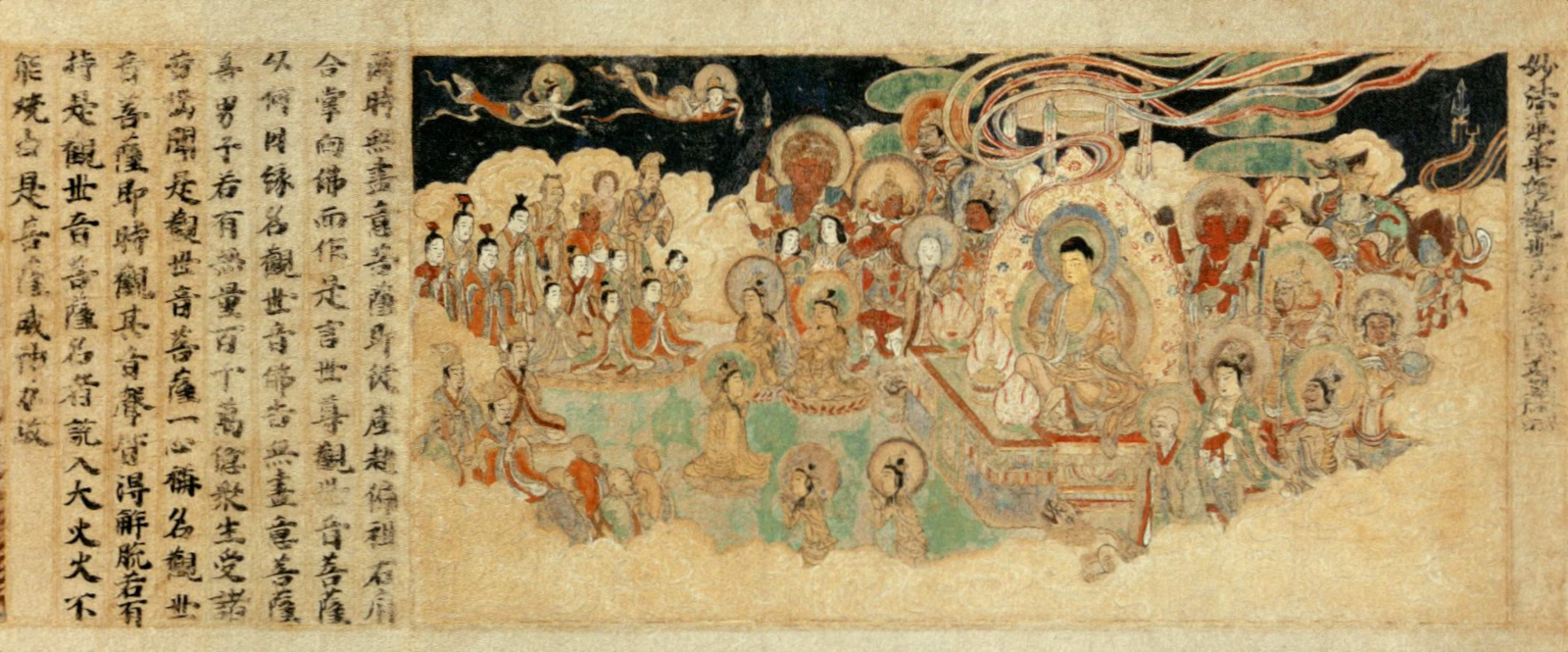
One should note the internal contradiction implied here in the text: the Lotus Sūtra is preached by the Buddha, and so within the narrative frame of the text he is, of course, not yet dead. But the text was clearly composed centuries after his lifetime, and thus its authors had to explain how it was that the Buddha had seemed to die. This is difficult to understand, and may be the reason that the text next presents a series of chapters highlighting the tremendous benefits to be gained by accepting the sūtra itself, as inconceivable as its teachings may be: chapters 16–19, Puṇyaparyāya (Enumeration of Merits; K: 17, Fenbie gongde pin [分別功徳品]); Anumodanāpuṇyanirdeśa (Instruction in the Merit of Sympathetic Joy; K: 18, Suixi gongde pin [隨喜功徳品]); Dharmabhāṇakānuśaṃsā (The Blessings of the Dharma Preacher; K: 19, Fashi gongde pin [法師功徳品]); Sadāparibhūta ([The Bodhisattva] Never Disparaging; K: 20, Changbuqing pusa pin [常不輕菩薩品]). These portions of the sūtra expound the merits to be gained by compassionate veneration and upholding of the sūtra, even against threats of violence and slander. Perhaps most notably, the Buddha relates how he himself had experienced persecution in a former existence as the bodhisattva Sadāparibhūta (“Never Disparaging”; Kanno, 2002). It is also important to remark that the sūtra itself, persisting in the world, comes to be seen as a relic of the Buddha and of his teaching, and thus as a sort of substitute for the Buddha. Chapter 20, Tathāgatarddhyabhisaṃskāra (Accomplishment of the Tathāgata’s Magical Power; K: 21, Rulai shenli pin [如來神力品]), portrays the miracle of the buddhas Śākyamuni and Prabhūtaratna stretching out their tongues up to the heavenly Brahmā world, which serves as a conclusion to the central event, namely the depiction of the entrustment of the teaching to the Buddha’s followers. Chapter 21, Dhāraṇī (K: 26, Tuoluoni pin [陀羅尼品]), contains spells (dhāraṇī) for the preachers of the sūtra. Chapter 22, Bhaiṣajyarāja (Medicine King; K: 23, Yaowang pusa benshi pin [藥王菩薩本事品]) is devoted to the deeds of the bodhisattva Bhaiṣajyarāja, and chapter 23, Gadgadasvara (K: 24, Miaoyin pusa pin [妙音菩薩品]; on the Sanskrit version of the name see Toda, 2002, 75–77) to the deeds of the bodhisattva Gadgadasvara. Bhaiṣajyarāja out of devotion offered his own body in firey worship, an act which, in various forms, was emulated by later devotees, who would burn parts of their body as offerings (Benn, 2009). Chapter 24, Samantamukha ([On the Bodhisattva] Facing Every Direction [i. e. Avalokiteśvara]; K: 25, Guanshiyin pusa pumen pin [觀世音菩薩普門品]; The Universal Gate of the Bodhisattva Who Regards the Sounds of the World) describes the benefits gained from venerating and invoking the bodhisattva Avalokiteśvara (Yü, 2001). This chapter gained wide circulation as an independent text, renowned especially for its promise of divine protection by the bodhisattva for any being who calls upon him in any circumstance of need; Avalokiteśvara promises to appear in a form appropriate to the needs of the being who entreats him. Thirty-three such forms are individually enumerated, the listing plainly meant to indicate the infinity of forms Avalokiteśvara might assume in order to aid beings in distress. (Note that Avalokiteśvara, or Guan[shi]yin, is depicted as a male bodhisattva in the sūtra, only later coming to be characterized as female.) The independence of a portion of this chapter as a separate text seems to have taken place in China.
Chapter 25, Śubhavyūharājapūrvayoga (Former Striving of King Śubhavyūha; K: 27, Miaozhuangyan wang benshi pin [妙莊嚴王本事品]), describes the deeds of several bodhisattvas and buddhas. In chapter 26, Samantabhadrotsāhana (Encouragement of Samantabhadra; K: 28, Puxian pusa quanfa pin [普賢菩薩勸發品]), the bodhisattva Samantabhadra vows to become the protector of those who venerate and uphold the sūtra. In chapter 27, Anuparīndanā (Entrustment [of the Sūtra]; K: 22, Zhulei pin [囑累品]), the Buddha exhorts the audience to preserve, preach, and transmit the sūtra.
Development
A comparison of the different versions of the Sanskrit and Chinese reflects a history of development in which certain chapters seem to have formed the nucleus of the sūtra, to which other chapters were later added. While the presentation in the different versions or translations is relatively uniform, there are differences in the number, length, and arrangement of the individual chapters, and the relation of prose and verse portions. For instance, as noted above in the sketch of chapter contents, the extant Sanskrit version in the Nepalese tradition comprises 27 chapters, while Kumārajīva’s translation has 28 chapters; the 11th chapter of the Sanskrit version entitled Stūpasaṃdarśana (The Apparition of the Stūpa), is divided between chapter 11, Jian baota pin (見寶塔品; Seeing [or: Manifesting] the Stūpas), and chapter 12, Tipodaduo pin (提婆達多品; Chapter of Devadatta), in Kumārajīva’s version, and later chapters are in a different order as well. Of Sanskrit sources, only the Kashgar manuscripts agree with the arrangement found in Kumārajīva, which represents a more developed form of the text. While there are, of course, also smaller scale differences in phrasing and the like, in terms of moderately sized variations, we should notice that the second half of chapter 5 (Herbs) is not found in Kumārajīva’s translation, though it is found in the Kashgar manuscripts. The first portions of chapters 8 and 10 are found only in Dharmarakṣa’s version. Sanskrit chapter 27, the final chapter, is chapter 22 in Kumārajīva. The verses in chapter 24 (K: 25), the famous chapter on Avalokiteśvara, are omitted by both Dharmarakṣa and Kumārajīva, though found in the Kashgar texts (Yuyama, 1996), later supplemented by Jñānagupta, while chapter 21 (K: 26) follows the Avalokiteśvara chapter, the latter sequential ordering of chapters here agreeing with Dharmarakṣa.
On the basis of doctrinal themes and textual form, it is assumed that chapters 2 through 9 belong to the earliest stage of the text’s formation, concentrating on the concepts of the “one vehicle” and “skillful means.” The second phase of development added the introductory and concluding chapters (1 and 27 [K: 22]), and probably also chapter 10, the first half of chapter 11 and chapters 13–21, which focus on the topics of the bodhisattva path, the veneration and the transmission of the sūtra, and the infinite life span of the Buddha. In the final phase of development, chapters 12 and 23–28, which are mostly dedicated to individual bodhisattvas, were included. The location of the preaching also changes from the Vulture Peak of the first portion to the “Assembly in Open Air” (虚空會) in the latter portion of chapter 11, with the apparition of Prabhūtaratna. This ends with what is the final chapter in Sanskrit, but chapter 22 in Kumārajīva’s text. Although the proposed relative chronology is convincing, it is difficult, if not impossible, to connect these three phases of growth to an absolute chronology.
The sūtra is divided into chapters that consist of both prose and verse (gāthā). On the whole the verse recapitulates the sense of the prose, which it generally follows. There has been much scholarly discussion concerning the relative dates of composition of the prose and verse. It has been hypothesized that the core of the text was originally in verse, although increasingly this view is falling out of favor, and indeed now seems to be highly unlikely.
Impact
Perhaps the greatest historical importance of the Lotus Sūtra lies in the position that it gained in East Asia, particularly through the rise and establishment of the Tiantai school in China, whence it spread eastward. Most notable here is the work of Zhiyi, which includes direct commentaries on the sūtra, as well as other exegetical works. In Zhiyi’s system of “classification and ranking” of Buddhist sūtras (panjiao [判教]), in which scriptures are hierarchically arranged according to temporal-biographical and doctrinal criteria, the Lotus Sūtra, together with the Mahāyāna Mahāparinirvāṇamahāsūtra, was assigned the ultimate position, not only representing one of the last teachings taught by the Buddha in his lifetime, but also the most complete and integral teaching of the dharma. Zhiyi’s two major commentaries, actually compiled by his disciple, Guanding (灌頂, 561–632 ce), are the Miaofa lianhua jing wenju (妙法蓮華經文句; T. 1718), a commentary on specific words and sentences of the sūtra, and the Miaofa lianhua jing xuanyi (妙法蓮華經玄義; T. 1716), an interpretation of its meaning and purpose, focused on its title. The monumental treatise on meditation, Mohe zhiguan (摩訶止観, T. 1911), is often considered a third Lotus Sūtra commentary.
Drawing on the sūtra, Zhiyi elaborated the important and very influential concepts of the threefold truth (sandi [三諦]) and the 3000 realms in a single thought-moment (yinian sanqian [一念三千]; Kanno, 1992). His scriptural source was Kumārajīva’s Chinese rendering zhufa shixiang (諸法實相), the “true aspect of the dharmas,” found in chapter 2, which is explained in the following passage as the “ten suchnesses” (shirushi [十如是]; Robert, 2011). Zhiyi read this passage in three different ways and understood the truth in three aspects, namely, emptiness (kong [空]), conventional existence (jia [假]) and the middle (zhong [中]). The concept of the “3000 realms in a single thought moment” indicates that every element in the universe can be found in the single moment’s vision of one’s mind. Zhiyi formulated his meditative practice with this understanding (Teiser & Stone, 2009b, 36). In addition to Zhiyi, and before him, a number of other scholars offered very influential interpretations of the sūtra, among whom at least Daosheng (道生, 355–434 ce; Miaofa lianhua jing shu [妙法蓮華經疏]; ZZ 577) should be mentioned.
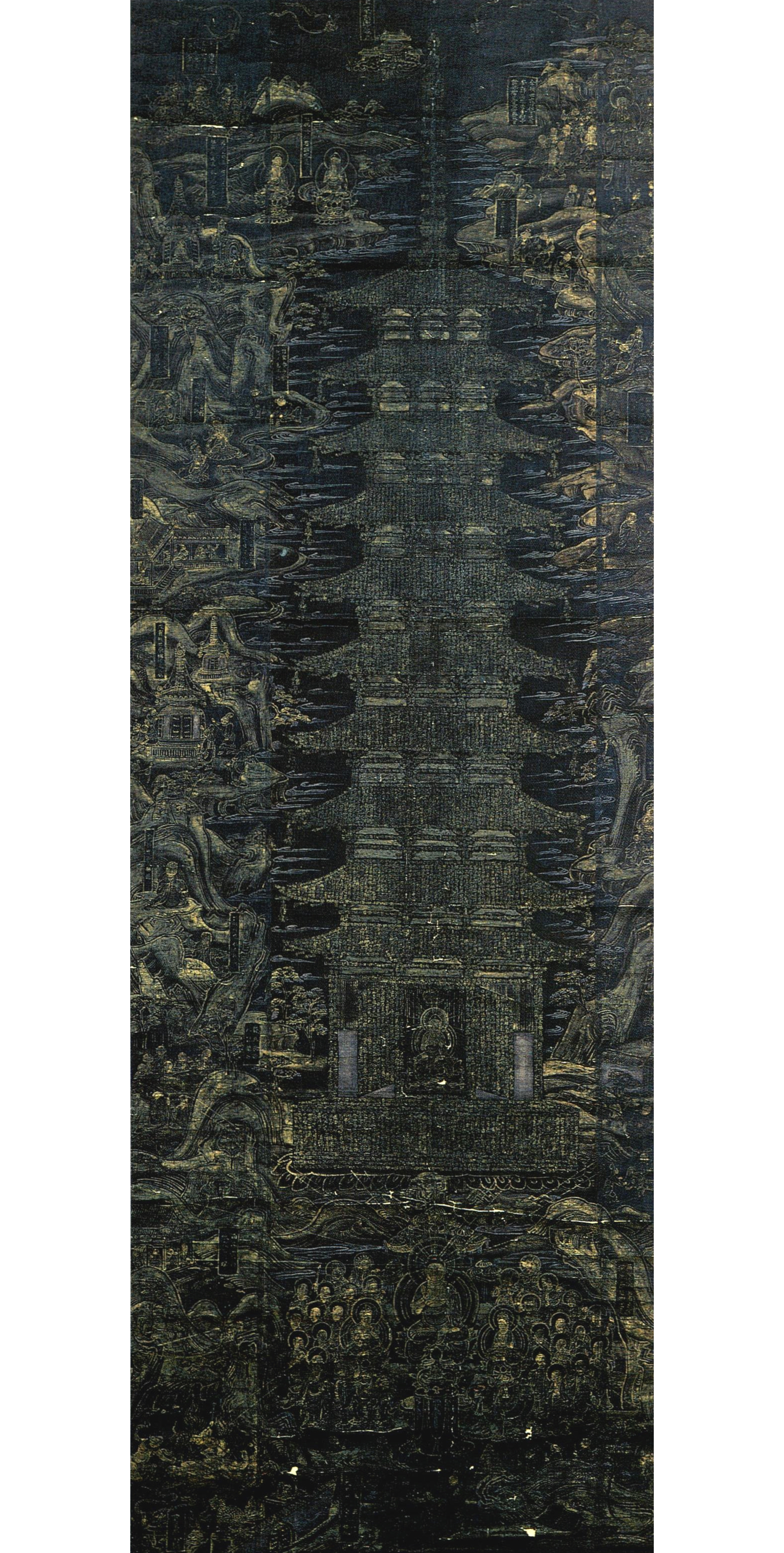
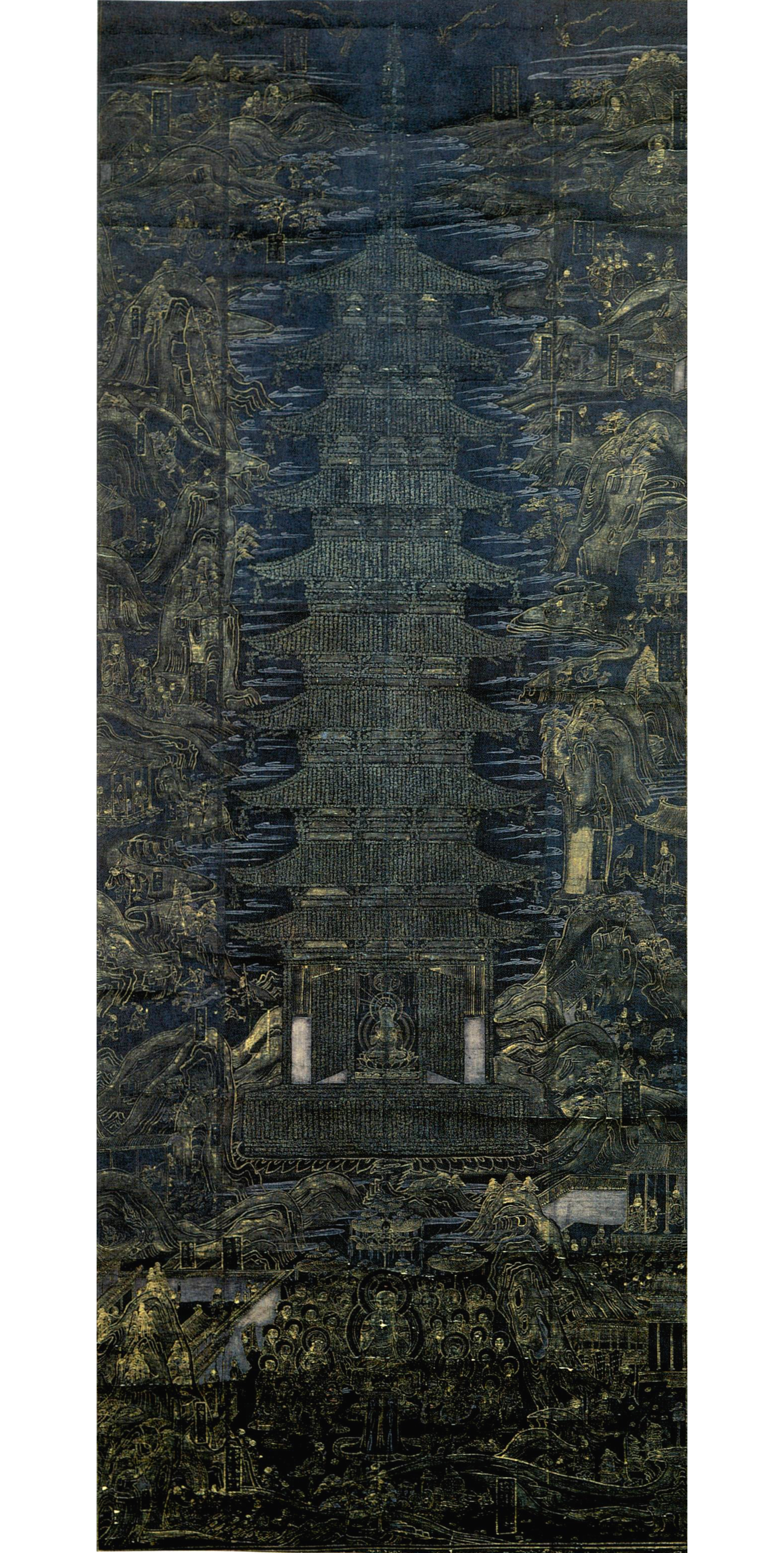
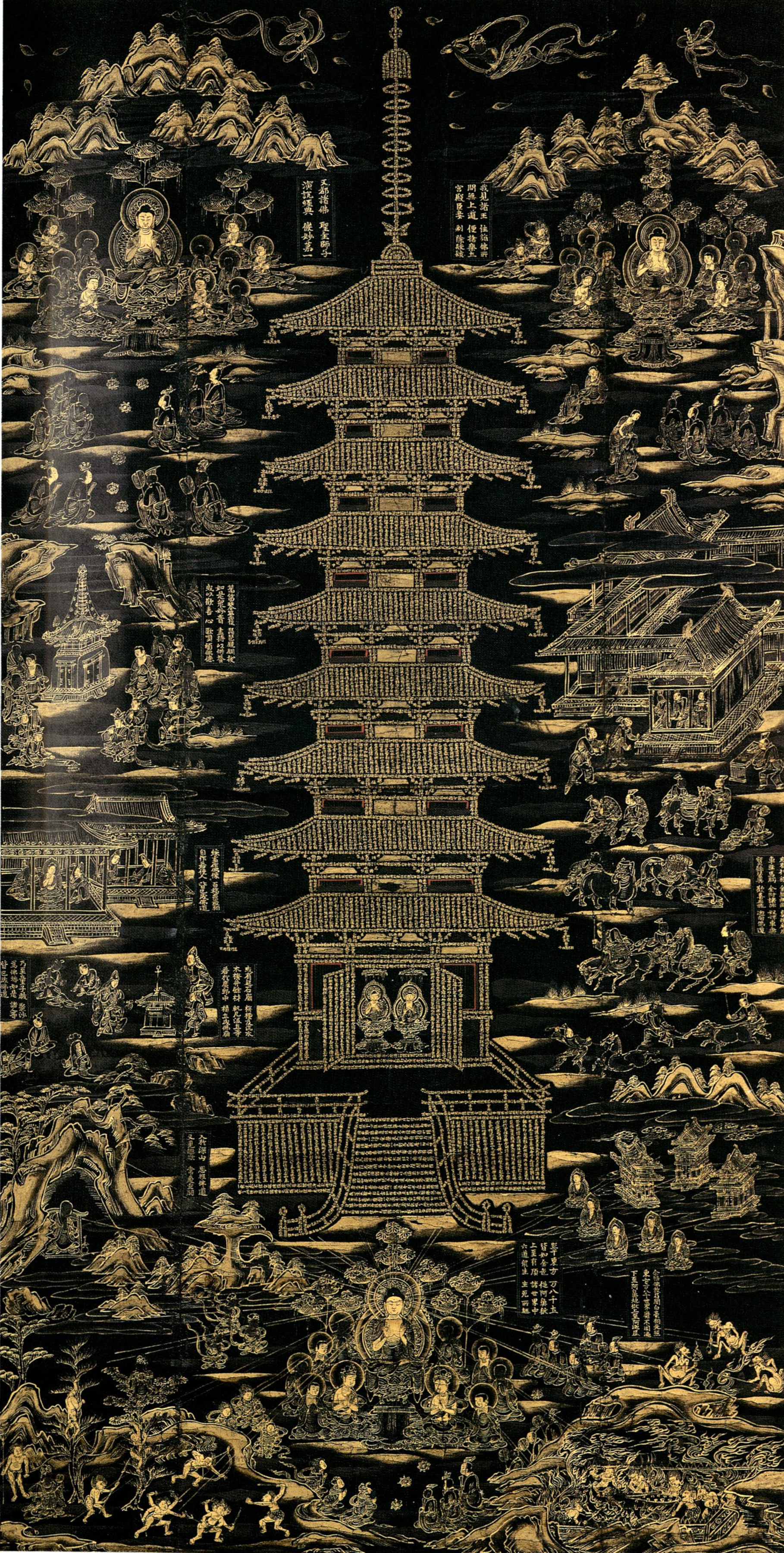
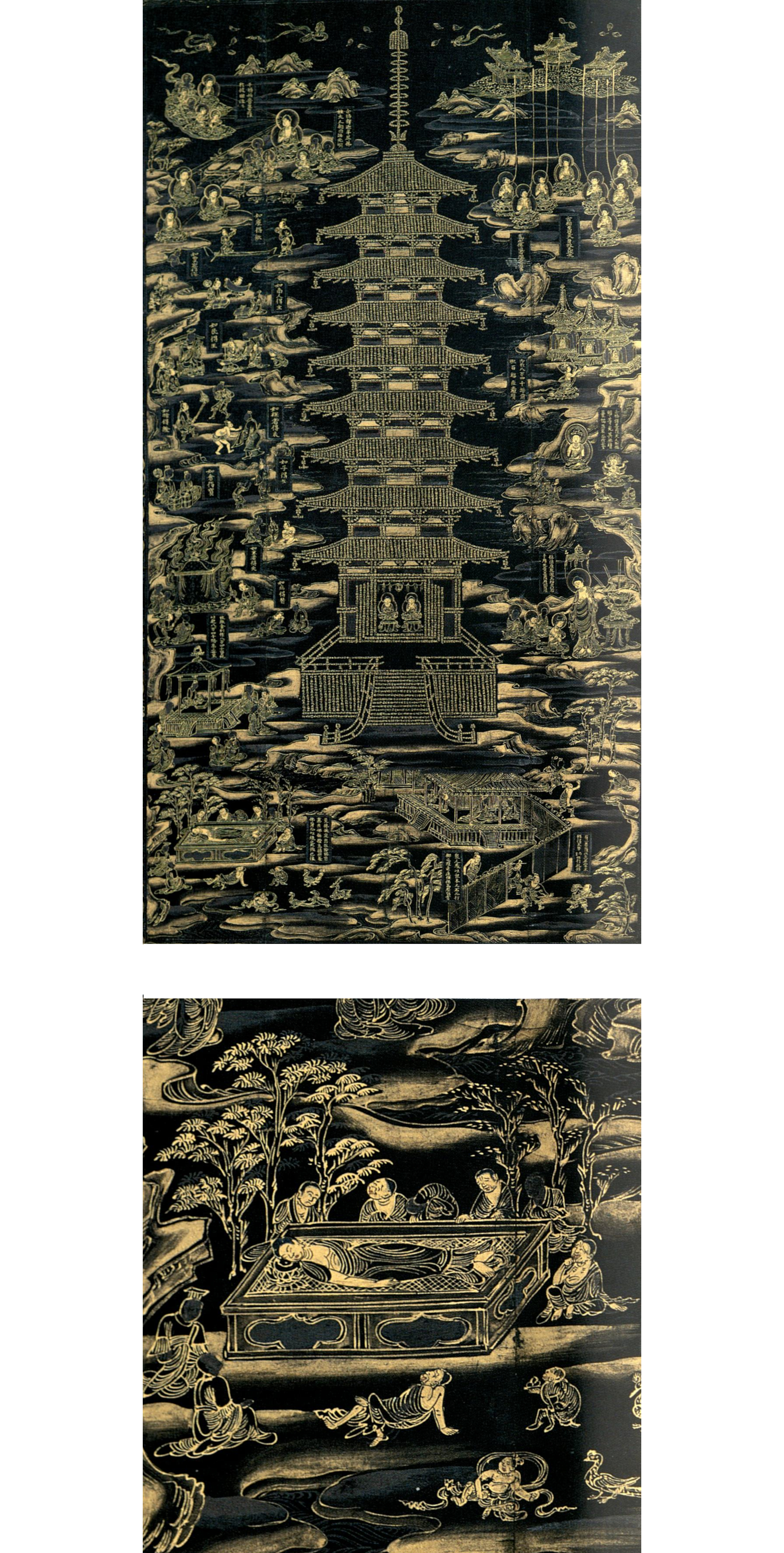
With its narrative, doctrinal and cosmological themes, the Lotus Sūtra not only had a strong impact on literary production in East Asian Buddhism and beyond, for instance in poetry, but also informed the visual arts, probably more than did any other Buddhist source. The influence of the sūtra on visual arts is seen already in an inscribed Buddha image from North India (von Hinüber, 2012), and richly reflected in the art of Buddhist China (Davidson, 1954; Wang, 2005) and Japan (Tanabe, 1988, 1989). Among the most prominent examples are images found in the Dunhuang caves, in Yungang (雲崗, from the Northern Wei [北魏], 386–534 ce) and in the contemporaneous Longmen site (龍門). In Dunhuang are found unique paintings and images based on the sūtra’s 11th chapter, depicting Śākyamuni and Prabhūtaratna sitting side by side (for example in caves 23, 38, 133, 159, 303, 331). The dual clay images of the two buddhas in cave 259 are thought to date to the Northern Wei, making them among the oldest examples in Dunhuang. The two buddhas are worshipped together with an image of the future buddha Maitreya, in front of whom one could be reborn by keeping and reciting the sūtra; in one’s last moments. The devotion due to the text is evident in wall paintings representing subjects or themes from the sūtra, as well as in uncountable artistically embellished copies of the text. Copying of the text was especially popular in the Sui (589–618 ce) and Tang (618–907 ce) periods in China, and in the Heian period in Japan. This was done with calligraphic features, such as the use of gold or silver ink, or artistic ones, visible in the Japanese Kinji hōtō mandara (金字寶塔曼荼羅), in which text is written in gold in the shape of a pagoda, the Ichiji butsu Hokekyō (一字佛法華經), in which each character of the Lotus Sūtra is accompanied by a buddha, or the Ichiji rendai Hokekyō (一字蓮台法華經), in which each character perches on a lotus flower. Activities of worship of the sūtra resulted from exhortations in the scripture itself about how it should be treated. In the Sanskrit text the description differs, but based on Kumārajīva’s translation they are eventually formulated into five merit-making practices with regard to the text, namely, keeping in mind, reading, reciting, explaining, and copying.
The sūtra’s stories and anecdotes also led to the production of popular narratives, demonstrating the miraculous salvific power of the text as well as of the Buddha and Guanyin, in particular (Dykstra, 1983; Stevenson, 1995; 2009). Scholastically speaking, it gave rise to broader doctrinal elaborations, not restricted to the Tiantai school but also produced in, or at least accepted by, other denominational groups. These include even, in Japan, Dōgen’s (道元; 1200–1253) and Hakuin’s (白隠; 1686–1768) Zen. Although Dōgen is considered an archetypical Zen master, and it is true that he in some sense rejected the authority of sūtras, he did cite them as proof texts, and among such citations the Lotus Sūtra is found most often, this and other evidence testifying to the pride of place he gave the text.
In Japan, the Lotus Sūtra has been one of the most popular and influential scriptures not only in the religious world of temples but also in the daily lives of ordinary people. The earliest record of the text in Japan is, at least according to legend, the commentary Hokke gisho (法華義疏, T. 2187) attributed to Shōtoku Taishi (聖徳太子) in 615 ce. This is heavily based (estimates range at around 70% of shared materials) on the Fahua yiji (法華義記) of Fayun (法雲, 467–529 ce).
In the Nara period (710–794 ce), the sūtra was given an institutional function as one of the most powerful means of warding off and avoiding calamities. In 741 ce, due to disaster, famine, plague and social unrest, the emperor Shōmu (聖武) erected a series of temples through the country, two to each province, one monastery and one nunnery. It was in each of the latter, collectively the kokubun niji (国分尼寺; state nunneries), that ten copies of the Lotus Sūtra were enshrined. These nunneries were termed hokke metsuzai no tera (法華滅罪之寺), “temples for the eradication of sin through the Lotus Sūtra.”
In the following Heian era (794–1185), Saichō (最澄; 767–822 ce) established the Japanese Tendai school and transmitted Tiantai hermeneutics and practices. Of the four types of Tiantai meditative practices (sizhong sanmei [四種三昧]) developed in China (Stevenson, 1986; 1987; 1999), the Lotus samādhi (Jpn. hokke zanmai [法華三昧]) took root in Japan as the most important Lotus-based ritual in the Tendai tradition. The repentance acts that were already integrated in the Chinese ritual were accentuated, following the introduction of new ritual manuals by Ennin (圓仁; 794–864 ce) and the samādhi was performed as a musical repentance liturgy (hokke senbō [法華懺法]).
New practices of the Lotus developed as well. A ritual, popular especially among aristocrats, was the hokke hakkō (法華八講), “eight lectures on the Lotus Sūtra,” based on the eight fascicules into which Kumārajīva’s translation was physically divided. Rather than focusing on edification per se, the main purpose of these rituals was the generation of merit (De Visser, 1935, 677–691; Tanabe, 1984). Yet another practice, documented from the mid-Heian period, and performed by monks and ascetics (hijiri [聖]) as well as lay persons, was that of reciting the title of the text (daimoku [題目]), chanted as Namu myōhō renge kyō [南無妙法蓮華經], “Hail to the Wonderful Lotus Sūtra!”
In the Kamakura period, the monk Nichiren (日蓮; 1222–1282) started to promote his own interpretation of the text. This was a time commonly understood to be the “last period of teaching” (mofa; Jpn. mappō [末法]), following a traditional schematization of the declining health of the Buddha’s dispensation, an age when there was felt to be little hope for the future. Japan saw a variety of strategies for coping with this situation, such as a particular devotion to the salvation offered by the Buddha Amida (阿彌陀佛) in his Pure Land. Nichiren, for his part, ascribed to the Lotus Sūtra an exclusive salvific and soteriological function, particularly in this time period, and regarded the daimoku as a powerful means of religious achievement. He identified with the Lotus Sūtra’s Jōgyō Bosatsu (上行菩薩; Bodhisattva Viśiṣṭacāritra), one of the bodhisattvas who emerged out of the earth and to whom Śākyamuni entrusted the future propagation of the text. (On Nichiren see Habito & Stone, 1999 [and the whole issue of the journal in which it appears])
The denomination that originated from Nichiren and his disciples is historically called the Hokke-shū (法華宗; Lotus Sect). It flourished in the Muromachi period (室町; 1337–1573) and was a predominant force by the 15th century in Kyoto, where some Hokke temples were given the status of chokugansho (勅願所), temples for offering prayers for the imperial family. Adherence to the Lotus Sūtra continued to grow, and the followers of Nichiren continued to develop their institutions. The Nichiren lineage split into several sublineages, and with the Meiji Restoration (1868), these were officially recognized as the Nichiren-shū (日蓮宗), Nichiren-shōshū (日蓮正宗), and a host of further subsects. In addition to these traditional denominations, since the early 20th century, lay movements based on Nichiren-inspired devotion to the Lotus Sūtra, such as the Reiyūkai (霊友会), the Risshō kōsei kai (立正佼成会) and, as the largest and most recent group, the Sōka gakkai (創価学会), have been very active. The religious orientation of these groups focuses exclusively on the Lotus Sūtra, to the virtual exclusion of all other Buddhist scriptures, and they continue to gain an increasingly large following outside Japan as well. In 20th-century Japan the universalistic ideals of the Lotus Sūtra, filtered through Nichiren’s interpretation, inspired both socialist oriented activitists and ultranationalists, eloquently testifying to the sustained power of the Lotus Sūtra.